
Allocation
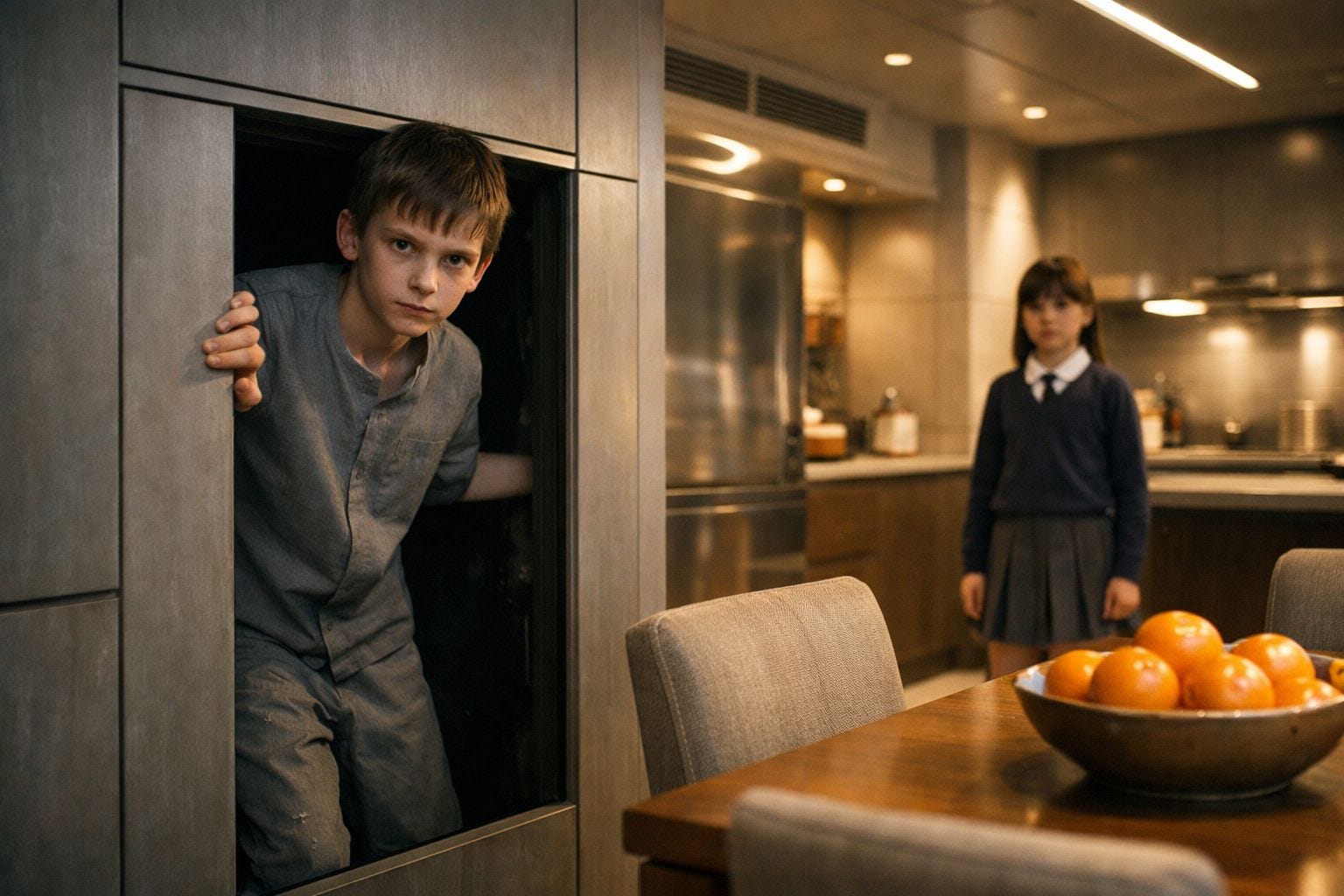
The food dispenser on Block C had been broken for eleven days.
Milo knew because he’d been counting. Breakfast came out cold and compacted into a gray cylinder that the younger kids called a slug. The dispenser made a sound when it cycled; a thin, persistent clicking; the sound of a loose heating element. He’d listened to it for eleven days. On the twelfth, he got up forty minutes before the first bell, pulled the access panel with a flattened wire he kept in his left shoe, found the element, and pressed it back into its housing until he felt the magnetic catch engage. It would not hold. He would have to procure one from elsewhere for a more permanent fix.
But on this morning, breakfast came out warm.
Nobody asked why. Nobody noticed. He put the panel back and washed his hands and stood in line with everyone else when the bell rang.
Center 7 occupied Sublevels 3 and 4 of the Detroit Undercity. The ceilings were low and the corridors ran in grids that never varied; same width, same height, same pale yellow light from panels that hummed at a frequency you stopped hearing after your first week. The air had a recycled flatness and he had never breathed anything else.
Every morning the duty board outside Block C posted assignments in order of labor classification track. Sanitation was always last. The light panels ran on an eighteen-hour cycle. Ten hours of work-light, eight hours of dark.
There were 340 children in Center 7. There had been 341 until three weeks ago, when Dex aged out.
The kids on Block C had a name for Sublevel 9. They called it the bottom. None of them had ever been there and none of them talked about it directly; much in the way you don’t talk directly about certain things when talking about them makes them more real. What Milo knew about it he’d assembled from fragments — a maintenance worker’s conversation heard through a ventilation grate two years ago, a single line in a Bureau orientation document, the specific way the older kids went quiet when someone’s Allocation date came up. He knew it was deep. He knew it was hot. He knew nobody came back from it.
Milo had watched the transport come.
It arrived during a lunch rotation. The corridor outside Allocation Processing was nearly empty. Milo had been tracking a ventilation fault in the northeast wall — a low vibration that wasn’t dangerous but wasn’t right — and he stopped when he heard the transport dock.
Dex came out of Processing in his gray issue clothes carrying nothing, because you didn’t take anything. He walked to the transport door, stopped on the threshold, and looked back down the corridor. It was as if he was looking for something. Milo raised a hand. Dex looked through him, or at him — hard to tell — and stepped inside. The door closed.
The transport disengaged.
Milo stood there until the corridor was quiet. Then he went to Block C and fixed the broken latch on Dex’s old cot. The one that had kept it from folding flat. Six minutes. The latch was broken. Now it wasn’t.
He found the shaft by following the fault.
The vibration led him through three maintenance corridors to a vertical shaft behind a recycling junction he’d never had reason to open. The internal dampeners were partially collapsed — that was the vibration — and the shaft ran upward a long way, which he hadn’t expected.
He fixed the dampeners. That was the job.
He came back the next day anyway.
On the third day, he climbed.
The rungs were cold and the shaft was dark from the first meter. Not dim, but dark; the kind that pressed against his eyes and stayed there. He found a rhythm with his feet and kept to it. Twenty minutes up he hit a junction he hadn’t known was there, a branching he couldn’t see. He stopped with both hands on the rung above him and listened.. Air moved from the left branch, slightly warmer. The right branch was still.
He almost went back down.
He stayed still long enough that the cold worked into his fingers. Then he thought about the shaft running upward a long way before he took the left branch and kept climbing.
Twenty more minutes; arms burning past the halfway point. At the top he found an access panel identical to every panel he’d ever worked with. He pressed his ear against it, then pressed the release and eased it open. He came out inside a wall cabinet in a kitchen.
He went still.
The kitchen was the size of his entire sleeping block. The ceiling panels were full-spectrum. He could tell immediately because the colors were different; richer, ike someone had adjusted a dial he hadn’t known existed. There was a table. Chairs with cushions. A bowl on the counter with six oranges in it.
He stood there for four minutes. He counted them.
Then he climbed back down and returned to Center 7 in time for the evening meal rotation.
Each visit after that the apartment was empty. He learned the family’s schedule and catalogued what needed attention. The corridor light panels were flickering on a four-second interval and the water recycler under the kitchen sink was running below optimal. He could hear it in the pump’s pitch, a pull that meant the intake filter was partially occluded. The filter itself he could clear. The pressure variance behind it he couldn’t fix without a replacement regulator he didn’t have, which meant the intake would keep occluding until someone addressed the source, so he left it alone.
On the eighth visit he cleared the intake filter anyway. It was the job he could do.
He was still under the sink when the front panel opened.
He stayed where he was. The cabinet door was partially open and he was visible from the entrance. He heard footsteps stop. Then silence, controlled and deliberate.
He came out from under the sink.
She was his age. Dark eyes. School uniform — Sublevel 1 standard.
“What are you fixing?” she said.
“Water recycler. Intake filter was occluded. It’s cleared, but the pressure regulator needs replacing or it will occlude again.”
She looked at the cabinet. Then at him. “You came from inside the wall.”
“Maintenance shaft.”
“You’re from the Center.”
“Sublevel 4,” he said. “Block C.”
She nodded slowly. “I’m Sable.”
“Milo.”
“Is it fixed?”
“For now.”
“Okay.” She set her bag on the table. “Do you want an orange?”
He came back. He shouldn’t have, but he came back.
She was home three afternoons a week; self-directed study, preferred at home. She worked at the kitchen table while he found broken things and fixed them. They talked the way children talk when they’ve both been, in different ways, alone for a long time.
She told him about school. About a project she was building — a model of a pre-collapse ecosystem, birds and insects and root systems all dependent on each other. She showed him the schematics on her tablet with a focused, proprietary energy, pointing out the load-bearing relationships. He found himself leaning in. She moved the tablet so he could see better.
He told her about ventilation systems. She laughed at something he said — a real laugh, surprised out of her — and he stopped mid-sentence.
She asked him why he’d gone quiet.
He said he hadn’t heard that before, someone laughing at something he’d said. She looked at him for a moment and said, with a flatness that wasn’t unkind, “That’s a terrible thing,” and went back to her work.
He asked if he could use her tablet and she pushed it across the table without looking up.
He read with both hands flat on the surface. Material science first, then fluid dynamics, then infrastructure systems — distributed networks, pressure architecture, the logic of how underground transit and utility grids routed themselves through the Undercity’s levels. He read the way he fixed things, tracing each system back to its source. He started mapping the shaft network in his head during his climbs — counting junctions, logging branches, building the structure level by level.
Three weeks in, she came home to find him replacing the flickering corridor panels and stood in the doorway watching.
“You could have asked me before starting that one,” she said.
He looked down at her from the stepstool. “It was bothering you.”
“That’s not the point.”
He got down. “I’ll ask next time.”
She held the doorway a moment longer. “It looks better,” she said, and went inside.
He finished the panels and stood in the corridor under the steady light. Then he folded the stepstool, went inside, and asked what else needed attention.
She didn’t answer immediately. She was at the window watching the projected sky running its afternoon cycle, pale blue shading toward amber. She had her arms crossed and wasn’t looking at her work.
“My father knows someone comes in here,” she said. “He hasn’t said anything. But he knows.”
Milo looked at the amber starting at the edges of the projected sky. He’d asked her once what was above it — above the Undercity, above the atmosphere processors, what was actually up there. Rock and heat, she’d said. Nothing left to go back to. They didn’t come back, the ones who tried.
He thought about that sometimes. He thought about it now.
“Does that change anything?” he said.
“I don’t know yet,” she said.
He nodded. She pointed him toward a loose panel in the back corridor and neither of them said anything else.
“What happens when you turn twelve?” she asked one afternoon.
“Allocation.”
“What does that mean exactly?”
He gave her the standard framing. Labor assignment. Productive integration. Civic purpose. Words he’d heard since he was small enough that he’d had to tilt his head back to see the faces saying them.
Sable opened the Bureau database and typed something. She read for a while without speaking. Her face didn’t move.
“Milo.”
She turned the tablet so he could see.
He read it. He went back to the beginning and read it again.
Sublevel 9 Mining Collective. Pre-contracted labor, non-transferable. Term: thirty years, commencing at Allocation.
His Center. His block designation. His labor classification track. Number of children currently enrolled: 40. Number of contracted labor units purchased: 40.
He read it a third time. Like slow reading might produce a different document.
It didn’t.
He put the tablet on the table and looked at his hands.
The number was forty. He knew all forty of them — the way they sat in the meal hall, which ones still flinched at the dark cycle, and which ones had learned not to. He looked at his hands and thought about all of them going into the bottom one at a time and then he thought about himself going in. Those two thoughts sat next to each other and wouldn’t separate.
Dex had been twelve.
The amber light was at the edges of the panels. He hadn’t known that color existed before he started climbing.
“I need to go,” he said.
His voice came out even. He was grateful for that.
He went back down the shaft. He fixed the broken latch on the access panel at the bottom — the one he’d been meaning to address for two weeks. His hands moved through it. He let them.
He was back under the sink four days later with a replacement pressure regulator he’d sourced from a decommissioned unit in Center 7’s lower maintenance bay — unsigned out, pocketed during rotation, the kind of thing nobody tracked. He had also taken the piece necessary to fix the cafeteria food dispenser permanently. The new regulator seated cleanly. The pump’s pitch changed, dropping to a steady low pull. He lay under the sink and listened to it, then began replacing the access panel.
The front panel opened.
The footsteps that came in were heavier than Sable’s.
He came out from under the sink.
The man wore an administrative uniform. Bureau insignia at the collar. His eyes moved from the open cabinet to Milo to the access panel on the wall and back to Milo.
“Papa.” Sable’s voice was careful. “This is Milo. He fixes things.”
The man looked at the gray issue clothes. The wire calluses on Milo’s fingers. The access panel half-replaced on the wall.
He walked to the wall panel beside the kitchen entrance and put his hand flat on it.
The room went quiet.
Milo watched the man’s hand on the panel and calculated four seconds to the wall cabinet, but he didn’t move.
“Papa.” Sable’s voice had changed. Not louder. Closer to something.
The man’s hand stayed on the panel. He was looking at Milo and Milo was looking back. Neither of them moved. The silence in the kitchen had weight.
The man took his hand off the panel.
He reached into his chest pocket, took out a stylus, turned it in his fingers once, twice, and put it back. He walked to the far end of the kitchen and stood at the window showing the projected sky — blue and still, a color that no longer existed anywhere above them — and put his hands at his sides.
“Go back down your shaft,” he said. “Don’t come back tonight.”
He didn’t turn around when he said it.
Milo went.
He was two days into his next rotation when he passed the duty board and stopped.
A maintenance audit notice. Shaft access irregularities, Sublevels 1 through 4, origin unspecified. Compliance review initiated.
He kept his face the same as always.
The audit had flagged the shaft network but couldn’t trace the access to a specific individual, only to the junction points between levels. That meant questioning. That meant someone working through the population systematically until the answers pointed at someone.
By mid-morning, Bureau compliance officers were in the corridor outside Allocation Processing.
He found Garrett in the equipment bay during rotation break. Garrett was eleven. Eight months until his own Allocation. Milo told him quickly what had happened.
Garrett listened. “Deep storage,” he said. “Behind the secondary recycling unit. Nobody checks it.”
“They’ll dock your rations.”
“Yeah,” Garrett said. He didn’t say anything else.
The storage room was three meters by two. Metal shelving on three walls, mostly empty. The secondary recycling unit ran continuously against the fourth wall, venting air that smelled of hot metal and chemical solvent. The floor was bare alloy plate.
Milo sat with his back against the shelving and his knees to his chest and he waited.
The compliance officers reached Block C on the second day.
He heard them through the recycling unit’s housing — voices in the ductwork, flattened and procedural. Not words at first. Just the rhythm of questions designed to have two answers.
Then closer.
He stopped breathing.
Two sets of footsteps outside the storage room door. Slow. Methodical. They stopped.
Milo pressed back into the shelving. A metal edge drove into his shoulder blade. The recycling unit churned beside him — heat and solvent and the low grind of it — and he calculated: door opens, two steps behind the unit, ventilation panel at floor level on the back wall, screws already loose.
The door handle moved.
It turned halfway and stopped. A pause — two seconds, three — and then the handle returned to center and the footsteps moved on.
One set. Then after a moment the other.
His shoulder blade pulsed where the metal had cut in. He was still not breathing. He made himself breathe and counted sixty seconds.
Then voices again — directly outside, not through the ductwork. His hand found the first screw on the ventilation panel behind him without him deciding to move it. He got two fingers on it.
The voices passed.
He sat with his back against the shelving and his fingers on the screw and waited.
Then Garrett’s voice in the corridor. Flat. Cooperative.
Haven’t seen him.
An officer’s voice, low. Garrett again. The footsteps continued down the corridor and didn’t come back.
Milo sat behind the recycling unit with his knees to his chest and the cold of the floor coming up through his shoes. The solvent smell was sharp enough to taste. His fingers were still on the screw.
He thought about Garrett’s ration card. About the two other kids who knew he was here. About the forty names in the document.
He thought about the orange Sable had peeled and handed him in sections on the ninth visit without asking. How it had tasted — sharp and sweet and entirely unlike anything he’d eaten before. He’d stopped chewing just to hold it still.
He hadn’t let himself think about any of it until now.
He sat until 0200. Then he climbed.
Getting to the maintenance core meant going up past Sublevel 1 to Sublevel 2, then traversing east through a junction duct he’d mapped on his fifth residential visit — three branches past the secondary riser, left at the pressure equalizer housing, the one with the cracked casing he’d noted and not yet fixed. He moved through it by the map in his head. His arms were spent from the climb. Halfway through the lateral section his left foot slipped and he dropped six inches before his shoulders caught him. He hung there, found his breath, found the wall again with his feet, and kept moving.
The maintenance core was long and blue — processing units down both walls, status displays throwing pale light across the floor. Empty. He moved to the audit system terminal.
The interface was nothing he’d worked with before, but the architecture underneath it was the same architecture he’d read about on Sable’s tablet — distributed authorization layers, input pathways tiered by credential level, the same logic as the utility grid schematics. They just pointed at personnel records instead of pressure valves. He built his map of it in seven minutes and hit the permissions barrier on the completion report function — supervisory sign-off layer, credential-gated, no way through the front.
He went around the back.
The automated maintenance pathway ran parallel to the supervisory layer — open by design, because a machine didn’t need credentials, only a correctly formatted request header. He’d read about the gap three weeks ago — a network infrastructure document, the kind written for engineers, not children. The author had called it a minor inefficiency. He formatted the header.
Eight minutes in, two errors backed out of carefully, and the file structure was taking shape. Then the staff entrance at the far end of the room opened.
He was behind the terminal housing before he’d decided to move. Flat against the back of the unit, arms at his sides, watching the door.
A compliance officer stepped inside. Standard uniform, tablet in hand. He didn’t look toward the terminals. He walked to the environmental control panel on the near wall, pulled it open, and ran a manual check — cycling through the readouts one by one, entering figures into his tablet, the methodical rhythm of someone completing a scheduled task, nothing more.
He was six feet from Milo’s terminal. The unfinished file was open on the screen.
Milo pressed flat against the back of the housing, looking at the environmental panel and the officer’s back. The terminal screen was visible past the officer’s shoulder. He breathed through his nose without making a sound. The ventilation panel at floor level behind the second processing unit was four steps to his left. He didn’t look at it. He looked at the officer’s back and the terminal screen and breathed.
The officer worked through his checklist. He made a note, scrolled back, confirmed something, made another note. He worked with the focus of someone with no reason to hurry.
Two minutes. Three.
Milo’s shoulder blades were against the back of the terminal housing — the same edge as the shelving in the storage room — and he didn’t move.
The officer closed the environmental panel. He made a final entry on his tablet. He walked back to the staff entrance, then through it, and the door closed behind him.
Milo counted sixty seconds behind the housing. Then he came out and finished.
Four more minutes. His hands are not steady, but steadier than before. The system accepted every file. He closed the terminal and moved.
Back through the lateral traverse. Down the shaft. Into the wall cabinet in Sable’s kitchen.
He stopped with his palm against the wood of the cabinet door. On the other side of it the apartment was dark and quiet. Sable was asleep somewhere in the back rooms. Her father was asleep. The table where he’d sat with his hands flat on the tablet. The chair with the torn seam on the left cushion that he’d thought about fixing every visit and never had.
He was nine years old. He had come up through the floor of a life he hadn’t known existed and found a person who handed him orange sections, said that’s a terrible thing, and told him to ask next time. Her father had turned a stylus in his fingers twice, taken his hand off the panel, stood at a window, and said go back down your shaft.
All of that was on the other side of this door.
He took his hand off the door and went back down to Sublevel 4. He got into his cot. He lay on his back in the dark.
The food dispenser clicked across the room. He lay there and listened to it — the cold still in the soles of his feet, the ache still in his arms, his shoulder blade pulsing where the metal had cut in. Underneath all of it, a hollowness. He’d felt that shape before, in the negative space left behind a repair — the outline of the broken thing in the fixed machine. Like a scar.
He lay there and felt it and didn’t get up for a long time.
The compliance officers were gone by morning.
The meal hall was loud the way it was always loud. There were trays and voices and the hissing of the dispensers cycling down the row; three hundred and forty children eating in shifts. Garrett was three tables over, eating his full ration. He looked at Milo and looked away. Milo understood.
Across the hall a younger kid was pushing a slug around his tray, not eating it, staring at nothing.
Milo watched him for a moment. Then he finished his breakfast.
He knew what the Center was now. Knew what the Bureau was. He knew what had used Dex up before the transport door closed and what was going to use up the other thirty-nine names in that document. He knew what was going to come for him.
He knew Sublevel 1 existed. He knew Sublevel 9 was below him, patient and already paid for.
After breakfast he went to the food dispenser. He took the back panel off and pressed a new heating element home until he felt the catch engage.
He put the panel back. He went to work.
Eight days later, during the afternoon shift change, Sable’s father walked into the Bureau’s personnel records office on Sublevel 2 and requested access to a file. The clerk at the desk didn’t look up.
The man sat at the terminal. He took the stylus from his pocket, set it on the desk, and didn’t use it. He entered a two-digit notation code with his fingers. Then he opened the transfer order and added a formal aptitude assessment request — mandatory review hold, procedural weight, transfer frozen pending outcome of gifting assessment. He made an administrative note. “Possible engineering level asset.” The Office of Labor Optimization had a backlog of four hundred and twelve cases — he knew this — and he filed the request anyway.
He logged out. He picked up the stylus, looked at it for a moment, and put it back in his pocket. He walked back to his office.
Three weeks later the notation and the hold appeared in Milo’s file.
Aptitude Unallocated. Mandatory review pending.
The Sublevel 9 contract required a clean file before transfer. The file was not clean. The transfer went into the assessment queue behind four hundred and eleven others, waiting for an office running at 60% to reach it.
It sat there.
In the meal hall on Block C, the dispenser ran warm—nearly hot.
In an effort to keep my work accessible to readers of all income levels, Bathroom Breaks & Bedtime Tales by Sevastian Winters is supported through ads, affiliate links, and reader donations.
If you enjoy a story, please consider restacking it on Substack and sharing it on your social media. Your support helps more than you know—thank you, and I hope you enjoy my work!
Sev