
Open Mic
The room is a galaxy of lights.
Gold spills from the chandeliers in long, glittering streaks across the crowd, catching the edges of glassware and polished instruments and the tiny mirrored faces of a thousand cameras. The air hums with applause—real applause, the kind that rolls across a room like distant thunder and seems to vibrate somewhere inside your ribs.
My name echoes through the theater.
I don’t quite recognize it at first. Seems too impossible.
It sounds like someone else’s life.
The announcer says it again.
Then suddenly everyone is looking at me.
People stand. People clap harder. My band shoves me out of the chair. Someone thumps my back so hard I nearly trip.
Album of the Year.
I walk toward the stage through a canyon of faces I’ve only ever seen on album covers and magazine spreads. Legends. People whose music raised me, terrified me, inspired me, made me practice until my fingers cramped.
They’re all smiling.
Which is strange.
Because I’m still the same short, thick, awkward kid who never figured out what to do with his hair.
The stairs creak under my shoes. The microphone waits in the center of the stage like a tiny metal moon. Someone presses the gold statue into my hand and suddenly the applause grows louder again, as if the room itself is relieved the trophy has finally reached the right pair of hands.
It’s heavier than I expected.
The lights are so bright I can barely see the crowd anymore - just silhouettes and sparkles and a faint shifting of shadows.
I clear my throat. Nothing comes out. A ripple of laughter moves through the room, gentle and patient.
I lean a little closer to the microphone. “Wow,” I say, because that’s all I have.
More laughter. The statue is cool in my hand, and for a second I run my thumb over the engraved letters on the base, like I’m checking to make sure they didn’t misspell my name.
They didn’t. Which still feels suspicious. “I probably should have written something down,” I say.
A few musicians in the front row grin and nod. They know the feeling. We’re not exactly a profession famous for prepared remarks.
“I didn’t,” I continue. Another wave of laughter. “So you’re all just going to have to survive whatever my brain does next.”
That gets a bigger reaction.
I glance out over the crowd again, and the brightness softens for a moment. I can just barely make out the outlines of faces now; rows and rows of people who, at one point or another, have probably stood in some little room somewhere holding a guitar or a microphone or a drumstick, wondering if anyone would ever listen.
The thing about rooms like this is that they look enormous from the outside. But when you’re standing here, they feel strangely familiar. Like a cafeteria. Or a student union. Or any other place where people are trying to figure out where they belong.
I adjust the microphone a little lower. Whoever used it last was taller. “I’ve been thinking about something lately,” I say. “I guess because moments like this make you look backwards a little.”
A pause. Not a lecture. Just a memory drifting up where the lights can catch it. “And the weird part is… I think the whole reason I’m standing here started in a high school cafeteria.”
That gets a few confused chuckles. Which is fair. Because it’s a strange place for anything good to begin.
The cafeteria always smelled like overcooked pizza and bleach. You could walk in blindfolded and still know exactly where you were from the sound alone—the scrape of plastic chairs, the clatter of trays, the thousand different conversations crashing together into one long echoing roar.
High school cafeterias have a geography. You learn it fast.
There are tables where the athletes sit. Tables where the band kids gather around battered instrument cases. Tables where the theater crowd performs entire musicals between bites of food.
And then there’s the table everyone pretends not to stare at. The cool table. It wasn’t actually labeled, of course. No sign hanging over it. No velvet rope. But everyone knew where it was.
The loudest table in the room. The one near the center where the confident kids leaned back in their chairs like they owned the building.
I stood just inside the doorway that first week of sophomore year holding my lunch tray like it was a fragile piece of machinery I might accidentally drop. I was already sweating.
Part of that was because I’d walked across campus carrying a guitar case on my back like a turtle shell. The other part was because I had absolutely no idea where I was supposed to sit.
Being short doesn’t help in situations like that. You end up looking at everyone’s shoulders instead of their eyes.
I shifted my weight and scanned the room. Athletes over there. Drama club near the windows. The robotics kids had already built a small city out of backpacks and calculators.
And the cool table sat right in the center of it all, laughing at something that probably wasn’t as funny as it sounded from across the room. I knew better than to try for that one.
But knowing something and believing it are two different things. I started walking anyway. Each step felt louder than it should have.
The tray rattled a little in my hands—plastic fork, carton of milk, something that might once have been chicken. I stopped about five feet from the table. Close enough to hear them talking.
One of the guys glanced up. He had perfect hair. Not the kind you fight with every morning in the mirror. The kind that just sits there like it signed a contract with gravity.
He looked at me for half a second. Then he looked back at his friends.
I stood there a moment longer than I should have. Sometimes hope has a slow reaction time. Finally I cleared my throat. “Hey,” I said, trying to sound casual and failing in several creative ways. “Mind if I sit here?”
That got everyone’s attention. Not angry attention. Just the quiet kind that falls over a table when someone asks a question with an obvious answer.The perfect-hair guy glanced at the empty chair next to him. Then back at me.
“Uh,” he said. The pause did most of the work. “I think someone’s sitting there.”
He didn’t point at anyone. No one objected. The chair stayed empty.
“Right,” I said. My face was suddenly very warm. “Got it.”
I turned around before my brain could invent any additional sentences and started walking again. The long walk. Every cafeteria has one. The walk where you move from table to table pretending you’re still looking for someone you know while quietly realizing you don’t actually know anyone at all.
The noise of the room seemed louder now. The laughter sharper. I passed the band kids. The robotics table. The theater crowd.
Every seat was already taken, or at least that’s what it looked like when you were the new kid holding a tray.
Eventually I reached the far corner of the room. There was a small table there. Empty.
No backpacks. No jackets. No invisible reservations. Just four chairs and a surface scratched with years of carved initials.
I stood there for a moment. Then I sat down. The plastic chair squeaked against the tile. For a second I thought about getting up again. But instead I opened my milk carton and took a drink. Sometimes the only way to survive a room is to act like you belong in it.
The strange thing about eating alone is that the first few minutes feel like everyone in the room is watching you. Not actually watching. Just… aware.
You start imagining that every laugh from across the cafeteria is somehow about you. That every chair scraping across the tile is someone shifting to get a better look at the weird kid in the corner.
Of course none of that is true. Everyone’s busy living their own little disasters. But when you’re sixteen and sitting alone for the first time, the room feels enormous and hostile and very interested in your failure.
I kept my eyes on the tray.
The pizza had already cooled into that stiff cardboard phase it reaches somewhere between the lunch line and the table. I folded it in half anyway and took a bite, mostly to give my hands something to do. The milk tasted like a refrigerator.
Across the room the cool table exploded into laughter again. Someone slapped the tabletop hard enough to rattle the salt shakers. I glanced up without meaning to.
The guy with the perfect hair leaned back in his chair like a king addressing his court. Everyone else leaned in toward him, waiting for the next thing he’d say.
For a moment I wondered what that felt like. Not the attention. Just the ease of it. The certainty that wherever you sat would become the center of the room.
I looked back down at my tray. Another bite of pizza. Another swallow of milk.
And that’s when the chair across from me scraped backward.
I looked up.
A girl I vaguely recognized from math class was standing there holding her tray. She had a stack of textbooks tucked under one arm and the kind of expression people wear when they’re deciding something small but important.
“Mind if I sit here?” she asked, awkwardly.
The question surprised me enough that I forgot to be embarrassed.
“Uh—no,” I said quickly. “I mean… yeah. Sure. Please. Welcome.”
She smiled and set her tray down. For a few seconds we ate in silence.
Then she nodded toward the guitar case leaning against my chair. “You play?”
“A little.”
“What kind of stuff?”
“Mostly whatever I’m trying to learn that week.”
“That sounds stressful.”
I laughed, which startled me because I hadn’t expected to.
She told me she played piano. Not well, she insisted, though the way she described Chopin suggested otherwise.
A couple of minutes later another chair scraped across the floor. This time it was a tall kid from my history class who always seemed half asleep. He hovered there for a second. “You guys mind?”
We shrugged in unison. “Welcome!”
He sat down. Within a few minutes the table held four people. A few minutes later, it held six. I didn’t notice exactly when the shift happened.
One moment it was just the lonely table in the corner. The next moment it sounded like every other table in the cafeteria—voices overlapping, someone telling a story, someone else laughing so hard they nearly spilled their milk.
It was our table. And it would stay ours for the rest of high school.
Across the room the cool table was still laughing, too. But suddenly it didn’t seem quite as loud. Or quite as important.
I didn’t think about any of that at the time. I was too busy listening to the history kid explain why our teacher’s obsession with the Civil War probably came from a traumatic childhood involving model trains.
But if someone had walked into the cafeteria right then and looked around, they might have noticed something interesting.
The table in the corner - the one that had been empty fifteen minutes earlier - was now one of the liveliest spots in the room. And nobody had asked permission for it to happen.
By the end of the week there were eight of us. By the end of the next, we were pushing other tables together to make a larger table. We didn’t plan it. No one declared the table official. People just… kept showing up.
The math girl brought a friend from the orchestra. The history kid dragged over someone from his chemistry lab who claimed he hated lunch crowds but somehow never missed a day at our table. A tall girl from the track team started sitting with us because, according to her, we were “way less exhausting” than the athletes’ table.
Someone else appeared with a sketchbook and spent most of lunch drawing caricatures of the rest of us. The table got loud. Not obnoxious loud. Just the comfortable kind of noise that comes from people enjoying themselves.
I started noticing other things too. Like how the cool table wasn’t actually that different from any other group. Same number of chairs. Same arguments over who stole someone’s fries.
Same bursts of laughter.
The only real difference was that everyone else in the cafeteria treated it like the center of gravity. And gravity, it turned out, was a weird thing.
It shifted. Sometimes slowly. Sometimes without anyone noticing.
One afternoon I looked up from my tray and realized something strange. Two kids were standing nearby holding their lunches.
They were doing the same slow scan of the room I’d done a week earlier, eyes moving from table to table. Looking for somewhere to land. One of them nodded toward our corner. “Is there room?” he asked.
There was. Someone pulled over another chair. Another chair followed. Pretty soon people were squeezing around the edges of the table, half sitting, half leaning.
The math girl was explaining something complicated about a calculus problem none of us understood. The sketchbook kid had drawn the history teacher as a vampire general leading an army of algebra textbooks.
Everyone was laughing again. And somewhere across the room the cool table was still doing its thing. But I noticed something I hadn’t before. They weren’t actually the center of the cafeteria.
They were just another table. The room had more than one place where people wanted to sit.
I didn’t have a name for the realization then. At sixteen you rarely do.
All I knew was that the seat I’d taken out of quiet desperation a few days earlier had somehow turned into the place people kept drifting toward.
And it happened for a very simple reason. Someone had sat down first.
By senior year I could walk into the cafeteria without thinking about where to sit. I knew where I belonged.
That alone felt like a small miracle.
The corner table had long since outgrown its original shape. We had dragged even more tables over during the winter, then another one in the spring when the orchestra kids discovered we had the best arguments about movie soundtracks.
People came and went all the time. Some stayed a week. Some stayed the whole year.
Nobody seemed to be in charge of it, which was probably why it worked.
The cool table still existed, of course. They were still loud. Still confident. Still leaning back in their chairs like they owned the building.
But they weren’t the center of the room anymore. Not really. The cafeteria had… options.
I didn’t think about it in any kind of philosophical way back then. I was too busy finishing homework five minutes before class and trying to keep my guitar strings from snapping in the middle of a song.
But something had shifted. I noticed it in small moments. A freshman standing in the doorway looking lost. I invited him over and watched him relax a little. Someone from another group drifted over just to see what the noise was about.
There was a quiet understanding that if you sat down with us, nobody was going to quiz you about whether you belonged.
One afternoon the guy with the perfect hair from the cool table actually wandered over. He didn’t sit. Just leaned on the back of a chair for a minute while we were arguing about whether Pink Floyd counted as “old people music.”
“Man,” he said finally, glancing around at the crowd squeezed into the chairs and standing along the edges, “your table’s getting kind of ridiculous.”
“Good ridiculous or bad ridiculous?” the math girl asked.
He thought about it. Then he shrugged. “Honestly? I think half the cafeteria’s over here now.”
And he walked away smiling.
That was the moment I realized something strange. Popularity didn’t move the way I thought it did. It wasn’t a throne someone earned. It was more like the weather.
It drifted toward the places where people seemed like they were having the most fun.
By the time graduation rolled around, the corner table had become one of those small traditions people talked about like it had always existed. The kind of thing freshmen heard about before they even figured out where the bathrooms were.
“Sit over there if you don’t know anyone,” someone would say.
“They’ll make room.”
I didn’t think of it as leadership. It was just lunch. But somewhere in the back of my mind a quiet understanding had started to form. Not fully. Not yet. Just the vague sense that rooms had invisible rules; and sometimes those rules could be bent.
College erased all of that in about fifteen minutes. New campus. New buildings. Thirty thousand people who had never seen my face before.
The cafeteria was gone, replaced by dining halls the size of aircraft hangars and a thousand little corners where nobody looked twice at anyone else.
I carried my guitar everywhere that first semester.
Not because I thought it would make me look cool. I was still short. Still thick. Still the same dumpy, pale dude with a bulbous nose and a prematurely receding hairline I have always been. Nothing was gonna make me look cool.
I carried my guitar everywhere because I was obsessed. I wanted to practice my music any chance I got, but also, didn’t know what else to do with my hands.
The music building smelled like wood and dust and old amplifiers. Posters from decades of concerts covered the hallway walls. Somewhere down the corridor someone was practicing scales badly enough to qualify as a crime.
It felt like home.
At least until Friday night.
That’s when I discovered the coffee shop.
The place was packed. Not just busy; packed in the way that makes a room feel alive. Students squeezed into mismatched chairs, leaning against walls, sitting cross-legged on the floor near the stage.
A small spotlight glowed over a microphone stand in the corner.
Open mic night.
The musicians rotated through the stage one at a time. Some were incredible. Some were brave. A few were both.
The crowd knew the regulars. You could tell by the way people cheered before the first chord even rang out.
There was a list near the bar where performers signed up. I stared at it for a while. Then I wrote my name down. That felt like progress.
I ordered a coffee and found a seat near the back of the room, guitar case leaning against my chair like an obedient dog. The music was good. Really good.
I watched how the regular players moved on stage; how they talked to the audience, how they settled into a rhythm like the room belonged to them.
The list of names moved slowly. Ten performers. Nine. Eight.
At some point someone from the coffee shop staff walked over to the clipboard and frowned. Then they erased my name. Just a quick line through it.
I walked up to the bar. “Hey,” I said, trying to sound casual. “My name was on that list.”
The guy behind the counter nodded. “Yeah. We’re out of time tonight.”
“Oh.”
He leaned a little closer, lowering his voice. “Mostly we keep it to the regulars,” he said. “You know how it is.”
I did know how it was. I had known it when I put my name down. I knew it when they called one of their favorites back to the stage to play a second song.
The room was still buzzing behind me; laughter, applause, another guitar starting up on stage.
I stood there for a second with my hands in my pockets. Then I nodded. “Right,” I said.
And for the first time since leaving high school, I felt something very familiar. Like a kid holding a tray in a crowded cafeteria.
I left the coffee shop with the guitar case knocking lightly against the back of my legs.
Outside, the campus air had that late-fall bite that makes everything smell faintly like leaves and cold pavement. Students moved past me in small clusters; jackets zipped, heads down, conversations drifting through the dark like loose threads.
Behind me the coffee shop door opened again. A wave of music spilled out—someone starting a song I almost recognized. Then the door shut and the sound disappeared.
I stood there for a minute. Not angry. Just… familiar with the feeling.
There’s a particular kind of rejection that doesn’t come with an argument. No insult. No scene. Just a quiet understanding that the room already belongs to someone else.
Mostly we keep it to the regulars. The sentence replayed in my head while I walked.
My shoes scuffed along the brick path that cut across campus. The music building glowed behind me like a lantern. The student union sat farther ahead, its tall glass windows shining against the dark lawn.
People were everywhere—studying, laughing, rushing toward late classes or early parties.
And the strange thing was that none of them seemed particularly concerned with the tiny social border war happening inside that coffee shop. They were just moving through their own evenings.
I shifted the guitar case higher on my shoulder. That’s when the memory slid back in. Not dramatically. Just a quiet little flicker in the back of my mind.
Plastic trays. Tile floors. A corner table. The cafeteria. I could see it clearly now; the long walk across the room, the empty chair, the moment the math girl asked if she could sit.
At fourteen I thought I had stumbled into something lucky. But standing there on the cold path with my name scratched off a list, it suddenly looked different.
The coffee shop wasn’t special. It was just another cafeteria. Same structure. Same invisible rule. There was a center table where the confident people gathered, and everyone else orbited it.
The realization settled over me slowly, like someone adjusting the focus on a camera lens. Rooms didn’t decide where the center was. People did.
The first people to sit down, speak up, or plug in their guitars quietly set the rules for everyone else.
I stopped walking.
Across the lawn the student union lights glowed bright and steady. Through the windows I could see students scattered across couches and tables, laptops open, coffee cups everywhere. A big open space with no stage and no list and no one guarding the microphone.
The thought came so casually it almost felt like someone else’s idea. What if the stage wasn’t the important part? What if the room was?
I stood there another few seconds, listening to the faint buzz of voices drifting from the building. Then I started walking again. The student union lobby was bright enough to feel like daytime.
Fluorescent lights hummed overhead. A few students hunched over textbooks near the windows. Someone was asleep on a couch with a backpack under their head.
No spotlight. No microphone stand. Just a wide open floor with chairs scattered in loose circles.
I stopped near the middle of the room. A couple of people glanced up; not suspicious, just curious.
I set the guitar case down. The clasps on the case snapped as I opened it.
The guitar came out warm from its padding, wood catching the white light overhead. I settled into a chair, rested the body of the instrument on my knee, and twisted the tuning pegs until the strings settled into place.
Nobody told me to stop. Nobody told me to play either. The first chord rang out soft and a little tentative.
A few heads lifted from laptops. I kept going. Nothing fancy. Just a simple progression I’d been practicing all week. My voice felt strange in the open room at first, like it had too much space to wander around.
But after a verse or two it settled. Music has a way of convincing rooms to cooperate.
A beautiful blonde girl who I never would have had the nerve to even speak to when I started high school stopped her studying nearby and leaned back in her chair to listen. I noticed the flute case near her.
“You play?” I asked.
She shrugged. “Yeah. A little.”
“Play with me,” I said.
She looked around nervously. “Here? She asked incredulously?”
“Yeah.” I said.
“With you or for you?” she asked. “Flute and guitar don’t really go together.”
“We’ll see,” I said with a practiced but arguably stupid looking wink.
She opened her case and started to play something simple. I joined in after a few bars and we started making music.
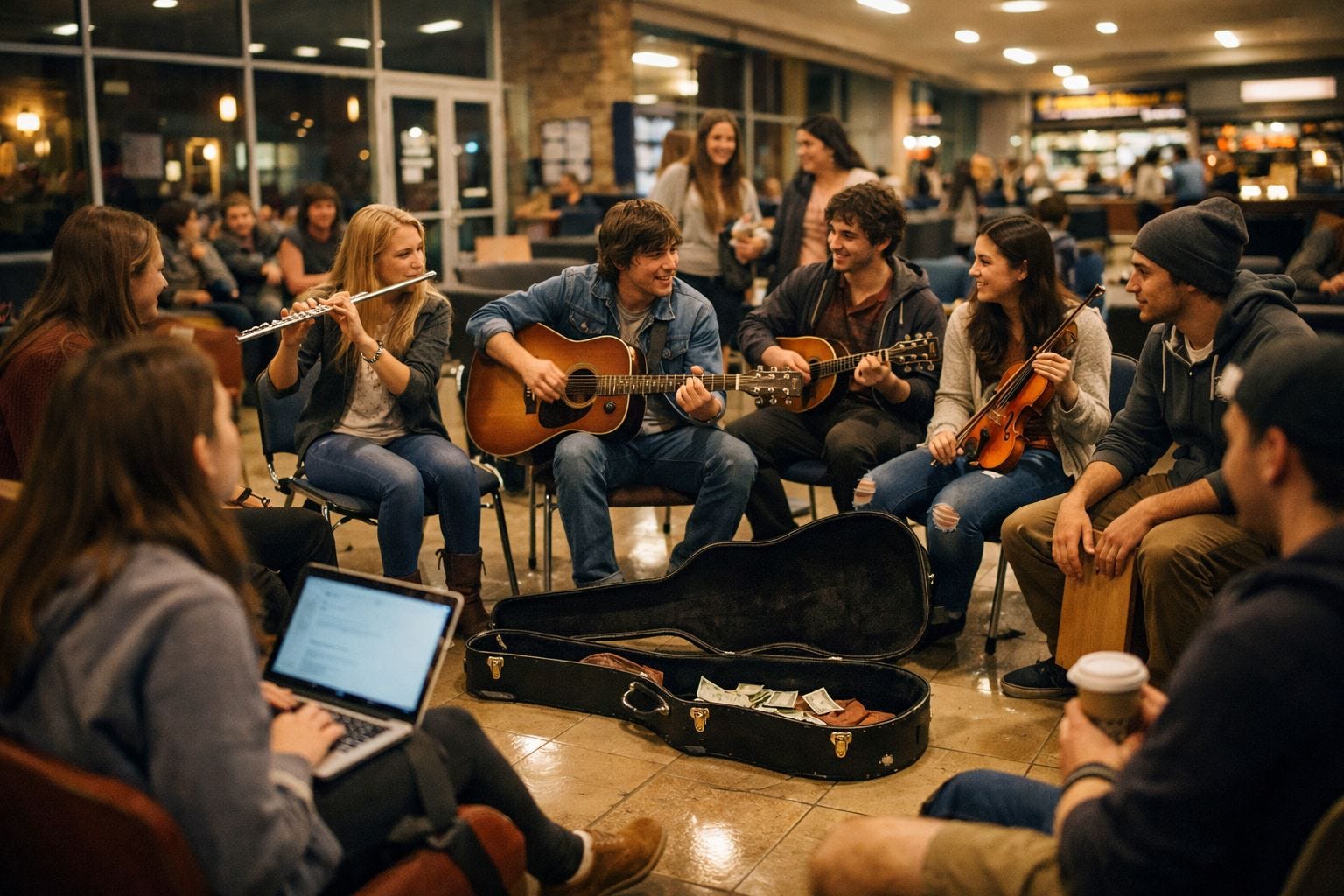
A guy with headphones around his neck slid one ear cup aside. Someone else dragged a chair closer. The circle formed slowly. Nobody announced it. Nobody organized it. People just drifted in the direction of the sound.
I finished the song and let the last chord fade out. For a second the room was quiet. Then someone clapped. Just one person at first. Then a few more.
I looked up. Five or six people were sitting around me now.
“You guys know any Johnny Cash?” asked one person watching.
“Probably,” I said.
“Play it.”
So I did. Halfway through the second verse a tall kid wandered over with a battered acoustic guitar slung across his back.
He waited until I finished. “Mind if I try one?” he asked.
I shrugged. “Pull up a chair.”
He sat down and started playing something bluesy and raw that made the little group lean forward.
Another musician showed up twenty minutes later. Then another. No clipboard. No stage. No regulars.
Just a loose circle of chairs in the middle of the student union where anyone who felt like it could pick up a guitar and see what happened.
At some point I looked around the room and noticed something familiar. People were still drifting in from the edges.
Drawn by the same quiet force that had filled a corner table in a high school cafeteria a few years earlier.
All it took was someone inviting someone else to participate.
For the first few weeks it felt like a coincidence.
A handful of students sitting in a loose circle on Tuesday nights, passing guitars around like someone had accidentally left the door open to a rehearsal room.
But college campuses are ecosystems. Energy moves fast. Word travels faster.
By the time the second month rolled around, people had started showing up on purpose. The first sign was the chairs. Someone from the student union staff rolled out a stack of folding chairs one afternoon and left them near the wall. The next Tuesday they were all gone within twenty minutes of the first chord.
The second sign was the musicians. Not just the curious beginners anymore. Actual players. The kind who leaned into their guitars with the quiet confidence that comes from a thousand hours of practice.
They came cautiously at first. You could see the hesitation in the way they hovered at the edge of the circle, guitar case still in hand, listening to whoever happened to be playing.
Then someone would scoot a chair back. “Come on in.”
And they would. No sign-up sheet. No stage. No one was deciding who deserved a turn. If you had something to play, you played. If you didn’t, you listened. That was the entire system.
One night a guy with a mandolin showed up and played a bluegrass run so fast the room erupted into laughter halfway through just from the shock of it. Another week someone dragged in a cajón and suddenly the whole circle had rhythm. Someone else brought a violin. Then a harmonica.
The room kept rearranging itself around the music like a school of fish shifting direction. Nobody owned the scene. Which meant everyone did.
I noticed something else too. Faces I recognized from the coffee shop started appearing in the back of the room. At first they didn’t sit; just leaned against the wall, arms crossed, listening.
One of the regular performers from the coffee shop - the guy who always played intricate fingerstyle pieces with his eyes closed - showed up three weeks in a row before finally stepping into the circle.
He waited until a song finished. “Mind if I try something?” he asked.
Someone handed him a chair. He played two songs. The room went quiet in the good way—the kind of quiet where everyone leans forward a little.
When he finished, someone across the circle nodded. “Man,” they said, “you should come back next week.”
He smiled like he had just discovered a place he hadn’t known he was looking for. Over time the migration became impossible to miss. Tuesday nights in the student union started filling the entire lobby.
Clusters of listeners leaned against the balcony railing above the circle. Students studying nearby quietly shut their laptops and turned their chairs to face the music.
Meanwhile the coffee shop across campus grew… quieter. Not empty. Just quieter.
One night a friend of mine who still played there came by the union circle with a grin. “You realize half our audience disappeared,” he said.
“Where’d they go?” someone asked.
He gestured around the room. “Here.”
No one made a speech about it. No one declared victory. The circle just kept growing.
Because once people realized they didn’t have to ask permission to join, they stopped waiting for someone else to give it to them.
The funny thing about the music industry is that it pretends to be different. Different rules. Different stakes. Different kind of gatekeepers.
But after a while you start noticing the same shapes repeating themselves. Different room. Same table.
Years passed. The student union circle turned into small shows at campus events. Those turned into gigs at coffee shops that used to ignore us. Someone started recording the sessions on a cheap handheld recorder and uploading them online.
The internet did what it does. A few songs spread farther than anyone expected. A tour followed. Then another.
At some point I realized people were singing along to words I’d written in the corner of a dorm room. Which was strange, because I still felt like the kid with the tray looking for somewhere to sit.
The professional side of music introduced a whole new set of rooms. Record label offices with glass walls and polished tables. Backstage areas where everyone wore black and spoke in quick whispers. Industry parties where the air smelled like expensive cologne and quiet competition.
The cool tables were still there. They just had better lighting. Managers with lists of artists who were allowed into certain rooms. Promoters who decided who opened for whom. Executives who talked about “market positioning” like it was a chess game.
More than once I sat in meetings where someone explained, very gently, that breaking into certain parts of the industry required “the right relationships.” Which is a polite way of saying the chairs were already taken.
For a while I tried to play along. Show up where I was told. Shake the right hands. Smile at the right moments. But something about the whole process felt familiar in the worst way.
Like standing in a cafeteria holding a tray.
Then one night after a show in a small theater, a group of younger musicians started hanging around near the stage. They had guitars. A keyboard. A drum pad balanced on someone’s backpack.
One of them asked if they could play a song while the crew finished loading equipment.
“Sure,” I said.
They plugged in and started playing. Nothing polished. Just raw, hungry music bouncing off the empty seats.
A few crew members stayed to listen. Someone grabbed another guitar. The circle formed almost automatically.
Standing on that stage with cables snaking across the floor and amplifiers humming softly in the dark, I felt the same quiet realization settling over me again.
Different room. Same rule. If the chairs you want don’t exist yet… you bring your own.
The first time someone told me the album had gone platinum, I was sitting on the floor of a rehearsal space eating takeout noodles from the carton.
There were cables everywhere. Drumsticks on the couch. Three guitars leaning against the wall like they had wandered there by accident and decided to stay. The place smelled like wood dust and stale coffee.
Someone read the message on their phone and said it out loud like they were announcing the weather. “Hey,” they said. “You know your album just went platinum.”
I nodded. Then I took another bite of noodles. It wasn’t that I didn’t care. It was just that the room I was sitting in felt more real than the number.
A couple of the musicians from the tour were arguing about a bridge section in a new song. Someone in the corner was quietly figuring out a harmony line on a keyboard that had definitely seen better decades.
The circle had gotten bigger over the years. Bigger rooms. Bigger audiences.
But the core of it hadn’t really changed. People still drifted toward the music. Toward the spaces where nobody had to audition for the right to be there.
I called the album Cool Kids. Seemed right. The title had come from a joke during one of those late-night sessions.
Someone had been talking about high school and the way everyone used to chase the cool table like it was the throne of some tiny kingdom. I told them about the corner table in the cafeteria. About the math girl. About the chairs slowly filling up. The whole room laughed.
“Man,” one of the guitarists said, “that’s the whole album right there.”
And in a way it was. The songs weren’t about high school. Not exactly.
They were about that feeling people get when they finally realize they don’t have to wait for someone else to hand them a seat. About the quiet moment when the room stops looking so intimidating because you understand something simple.
Someone has to include others first.
The industry tried to make sense of it in more complicated terms. They used words like movement and grassroots audience and organic growth. But most of the musicians who ended up playing on the album understood the truth instinctively.
They’d all been the kid with the tray at some point. The album spread in the same way the cafeteria table had. Then the student union circle. Then the late-night jam sessions after shows.
People heard the music and felt like they were allowed to step into it. Like there was room for them there. And once that happened, the numbers took care of themselves.
You could have knocked me over with a feather when someone told me the record had been nominated for a Grammy. A few months later they said it had been nominated for several.
Then suddenly I was sitting in a theater full of famous people holding a gold statue that felt suspiciously heavy in my hand.
The applause fades eventually. All applause does.
Standing at the microphone, I shift the little statue from one hand to the other and glance out over the crowd again.
The lights are still bright enough that I can only see pieces of faces. A pair of glasses in the front row. Someone wiping their eyes while they laugh. Musicians leaning back in their chairs the same way the cool kids used to lean back at that cafeteria table.
For a second I consider saying something profound. Something that sounds like a proper acceptance speech. But that has never really been my thing.
Instead I glance down at the small card tucked into the base of the trophy.
Artist of the Year — Cool Kids.
I smile.
“You know,” I say into the microphone, “when I was sixteen I tried to sit at the cool table in my high school cafeteria.” A ripple of laughter moves through the room.
“I didn’t get the seat.” More laughter.
“But something interesting happened after that.” I pause. Not long. Just long enough to let the room settle again. “I sat down at another table instead. One nobody was using.”
The musicians in the crowd are already nodding. They know where this story is going. “And people started sitting down too.”
I shrug a little. “That turned out to be a pretty useful life skill.”
The audience laughs again. I glance over my shoulder toward the wings of the stage where my band is standing.
A few of the musicians who played on the album are there, too; people who wandered into jam sessions years ago and never quite left.
“This record exists because a lot of people pulled up chairs,” I say. “No auditions. No velvet ropes. Just… chairs.”
I look back out at the room. “So if you’re somewhere tonight with a guitar or a keyboard or a drum machine and you’re waiting for someone to give you permission to play…” I let the sentence trail off with a small shrug. “You probably don’t need it.”
The crowd cheers softly at that. I lift the statue a little, not like a victory but more like a toast.
“Thanks for sitting down with us,” I say. Then I step away from the microphone and walk offstage, leaving the lights and the applause behind as the circle gets a little bigger.
Backstage smells like sweat, coffee, and electrical equipment that’s been running too long.
Someone claps me on the shoulder as I step through the curtain. Someone else hands the statue to a stagehand so I don’t drop it while people are hugging me.
The hallway is crowded. Band members. Friends. A few musicians who played on the album leaning against the wall with the relaxed smiles of people who have already decided the night was worth it even before the trophy showed up.
The drummer from the tour pulls me into a hug that nearly knocks the air out of my lungs. “Man,” he says, laughing. “You totally deserve it.”
“I probably just ended the Grammy’s forever” I say. “They should have found a better speaker.”
Someone hands me a plastic cup of something that might be champagne.
Across the hallway the hot blonde flautist from the student union pauses from wiping our two year old’s punch stained face to say, “Look! There’s Daddy!” She’s still wayyyy too hot for me. Thankfully, she doesn’t know that.
“I hope I didn’t mess up too bad,” I say.
“You were great,” she says, kissing me softly. We embrace. Group hug as a family.
I lean against the wall for a second and let the noise drift around me. It’s strange how familiar it feels. Different building, better lighting. More famous faces.
But the structure of the room isn’t all that different from the ones that came before. Small clusters of people laughing together. Musicians comparing stories. Someone somewhere tuning a guitar even though the show is technically over.
Across the hall a young singer I don’t recognize is standing near the wall with a guitar case slung over one shoulder. Roadie’s kid, I think. She looks like she’s trying to decide whether it’s okay to be here.
I’ve seen that expression before; fourteen years old with a tray in my hands. Standing in the doorway of a cafeteria. I walk over.
“You play?” I ask, nodding toward the case.
She blinks a little, surprised that someone noticed. “Yeah,” she says.
“Good,” I tell her. “Wanna’ jam?”
Behind us the hallway is filling up with more musicians drifting out of the main room, talking over each other about songs and performances and whatever happens next.
Someone is already dragging a chair over to the corner. My drummer spots the guitar case and grins. He knows what happens next.
Someone else plugs a small amp into a wall outlet. The young singer hesitates for another second. Then she sets her case on the floor and opens it.
The guitar comes out slowly, the way instruments always do when they’re about to join a room full of strangers.
She looks up at me. “I’m just learning”
“We all are,” I say. Someone hands me a guitar and I begin to follow her lead. She’s not bad. I show her a couple of things.
An audience starts to gather. “Pull up some chairs,” I call out.
The drummer finds a beat and we find our groove. The newcomer offers up a smile.
More people wander closer. And just like that another cool kids table starts filling up.
In an effort to keep my work accessible to readers of all income levels, Bathroom Breaks & Bedtime Tales by Sevastian Winters is supported through ads, affiliate links, and reader donations.
If you enjoy a story, please consider restacking it on Substack and sharing it on your social media. Your support helps more than you know—thank you, and I hope you enjoy my work!
Sev