
The Interpreter
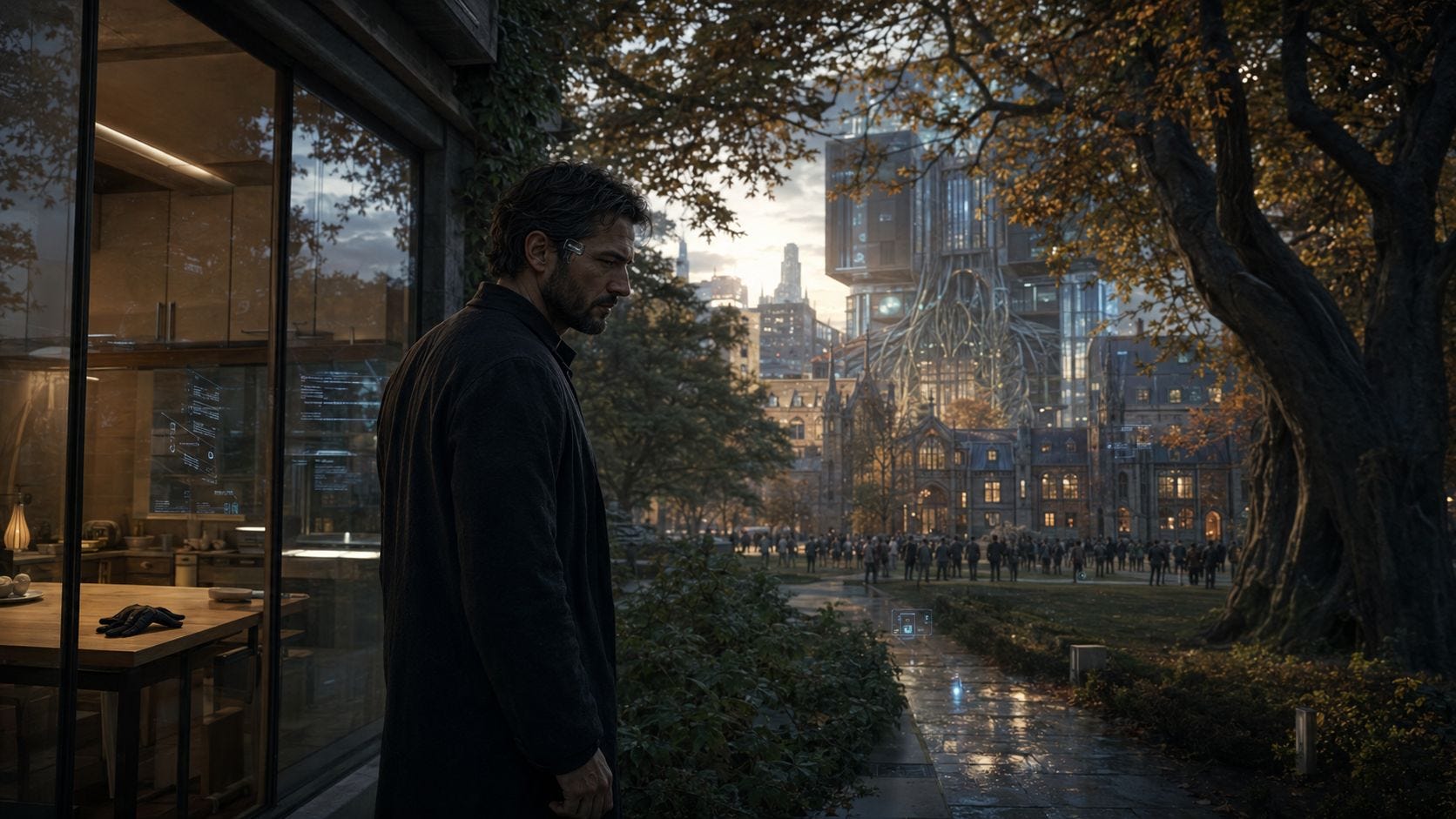
The session runs forty minutes over schedule because the Integrated faculty representative needs to feel heard before she can hear anything. Gideon has learned to give her that without losing the room. He sits between the two delegations at the long table in Mediation Suite C and does what partial augmentation allows: receives both cognitive signatures at once, enough Integrated architecture to read her distress as data, and enough unaugmented baseline to hold the Remnant coalition’s distrust without triggering it. He translates. Not language — they share language. Register. The specific frequency of meaning that gets lost between one kind of mind and another.
The agreement they reach is narrow: a shared equipment protocol for the third-floor labs. It will hold for six weeks, maybe eight. Nine years of this work and Gideon knows what six weeks looks like.
He takes the exterior stair down from the third floor. The covered arcade runs the same route, and faster, but he has not used it since his second year on campus. That was when he learned what the roofed enclosure does to the haptic bleed — the ambient cognitive residue of every hand that has touched those railings and every mind that has moved through that compression of space. His gloves manage direct contact. They do not manage proximity. He tells people who ask that he has a sensitivity to covered spaces. He tells no one the rest.
Rufus is waiting at the base of the stairwell with two drinks — coffee for Gideon, milk in a wine glass for himself. He has been doing this since Gideon met him eleven years ago and Gideon has entirely stopped noticing.
“How’d it go?” Rufus asks.
“Equipment protocol.”
“World peace.”
“Give it eight weeks.”
Rufus hands him the coffee and they walk. The campus in late afternoon light is all glass and root-structure, the original university buildings threaded through with sixty years of expansion—new towers with augmentation infrastructure visible in the walls, the old quad where the Remnant faculty coalition meets because the signal density there is low enough to think in. Gideon has spent nine years learning every frequency gradient on this campus. He routes by feel more than map.
Rufus had been talking about leaving for three years. The car he’d identified was a restored 2180 Carrera with a combustion engine, which was either a collector’s investment or a statement. It was always both with Rufus. One more semester, he said. He was finishing a theoretical framework on cross-architecture cognition that had been almost finished for four years. Gideon had stopped asking about it because the asking made something in Rufus go quiet.
“I enrolled in the bridge program,” Rufus said.
Gideon looked at him.
“I know what you’re going to say.”
“I haven’t said anything.”
“You’re going to say the data protocols are proprietary and nobody knows what they actually do with it.”
“That’s true.”
“I want to know what it’s like.” Rufus held his wine glass with both hands, the way he did when he was saying something he’d thought about for a long time. “From inside. Just once. I’ve spent eleven years writing about the gap and I’ve never been in it.”
Gideon didn’t say what he thought about the bridge program. He said: “When do you start?”
“Thursday.”
They walked. The campus moved around them in the late afternoon.
The notification arrived six weeks later, on a Wednesday morning.
Adverse neural event. That is the phrase the university uses—adverse neural event, consistent with interface incompatibility in subjects with certain baseline cognitive profiles. The bridge program’s informed consent documentation had noted this as a possible outcome. Rufus had signed the documentation. The program director expressed condolences. The university expressed condolences. The Remnant coalition held a gathering in the old quad. Gideon stood at the edge and watched people who had known Rufus for years say the right things and mean them.
He had one glass of milk in a wine glass, afterward, and poured it into the grass when no one was watching.
The institution moved on. There was a memorial in the calendar for one month out, a naming opportunity for a study room in the new Remnant wellness center, and a small scholarship endowment that the bridge program contributed to. Gideon thought about it for a long time.
The hallucinations had been manageable before Rufus died.
Not accurate. They had been managed. The partial augmentation that makes Gideon functional as an interpreter also makes him permeable — cognitive residue from the sessions he runs, from the augmented surfaces his nervous system registers through the gloves and through proximity, and through the sheer density of modified minds that inhabit this campus. His neurologist calls it a bleed. She has not filed the formal report for seven years because Gideon asked her not to. She understands what the formal report would mean for his certification.
The bleed changed after Rufus died.
It arrived with a texture he had not encountered before; not ambient residue, not session overflow. It was something that had the shape of a person he knew. Fragments. A room he had never been in, rendered in the flat sensory profile of a neural interface recording. Rufus’s voice, saying something Gideon could never quite catch before it dissolved. Rufus’s cognitive signature, which Gideon had not known he’d memorized until he found it arriving at 3 a.m. in his apartment, dissolving before he could establish what it contained.
He wore his gloves to bed for two weeks before he stopped.
He could not tell what was residue and what was memory and what was something else.
His neurologist had noted this once, early in his certification; that in partial-augmentation subjects with long-duration interface exposure, residue and actual memory were clinically indistinguishable after extended periods. She had said it as a warning. It had not felt like one.
The announcement came on a Thursday. Not a mediation outcome; no process, no neutral party, no session on his calendar. The Integrated faculty senate and the Remnant coalition issued a joint statement at 9 a.m. and by noon the provost had sent a campus-wide message calling it a historic moment. There were photographs of both sides together.
Gideon read the statement three times and called the provost’s office. She was in meetings. She would return his call at her earliest opportunity.
He filed a formal inquiry with the research ethics board, noting the timing relative to Rufus’s death and requesting access to the bridge program’s data protocols. Acknowledgment within four hours: received, reviewed within thirty days.
He contacted three members of the Remnant coalition he had worked alongside for nine years. Two did not respond. The third met him in the old quad on a Tuesday evening and told him, without looking at him directly, that the agreement was good for the community. She hoped he would find a way to support it.
“Did anyone ask what the agreement was for,” Gideon said.
She looked at the grass. “We were shown the terms.”
“That’s not the same thing.”
She left before he did.
The provost called on day twenty-nine. Gideon laid out what he had: the timing, the lack of process, the bridge program’s proprietary data, and Rufus’s death. She was warm and specific. She said she understood his grief. She said the peace agreement was the result of years of quiet relationship-building that hadn’t required his involvement. She said she would have him removed from the interpreter certification registry if he continued the inquiry through official channels. She said this the same way she said everything else, and then she ended the call.
He walked home. At some point between the main concourse and his building he understood he had been composing an account of the call to give to Rufus. The shape of the story, the particular line: She said it the same way she said everything else, you would have—
He went home and stood in the kitchen for a while before he realized he had been about to make two drinks.
His interpreter certification gave him access to the bridge program’s session architecture. Not the proprietary data, but the infrastructure; the mapping of how sessions connected, who had been in which interface, and when. This access existed because an interpreter sometimes needs to understand the cognitive environment a subject has been in before a mediation session.
He used it on a Sunday night in April, in his apartment, with his gloves on the kitchen table.
He knew what he was doing. The access would be logged. He spent two hours with Rufus’s session records — the metadata, the connection logs, the architecture of what had been done to him — before he understood what he was looking at.
The certification flag arrived Monday morning. Access revoked. Both the Integrated senate and the Remnant coalition withdrew their mediation requests within forty-eight hours. Three sessions on his calendar, all rescheduled with a replacement interpreter assigned.
He taught his Tuesday seminar. Eleven students, cross-architecture theory, nobody yet aware of the flag. Gideon taught the session, then took the exterior stair down, and walked home through the frequency gradients he had spent nine years memorizing. He was not afraid; not yet.
What Rufus had found was not in the session architecture. It was in an archive file Rufus had transferred the night before his final session, routed through the old quad’s low-signal environment that the augmentation infrastructure didn’t monitor well.
Gideon had the archive address from something Rufus said eight months before he died, a throwaway line during a conversation about data security that Gideon had not understood at the time and had filed in his memory anyway, the way he filed everything.
The bridge program had not been mapping the experiential gap between Integrated and Remnant. It had been mapping resistance. The neural signatures associated with non-compliance — the cognitive architecture of minds that question, refuse, and remember. The baseline for the peace agreement’s implementation protocol was a suppression delivery system designed to target those signatures, not obliterate them. Attenuate them. Soften the edges of the thinking that would cause someone to look at the agreement and ask what it was for.
Rufus’s session notes, three pages in his handwriting, photographed and added to the archive: I think I know what the data is for. I think I’ve been helping them build it. And then, written and crossed out and written again: I don’t know if telling Gideon helps or just breaks something else.
Gideon read that line four times.
The bleed arrived while he was reading it, not dissolving this time.
A room. A chair. The interface equipment in the order you would see it arriving. He was not seated yet when it started. The technician’s back. The old quad had smelled different from the rest of the campus and Rufus had always said—
Gideon put both hands flat on the desk.
Rufus’s last clear thought before the adverse neural event: he’s going to want to fix this.
The timestamps on the second set of notes began fourteen months after Caravel first made contact with Rufus about the buried data. During those fourteen month there had been a contract renewal and a promotion to lead researcher on the bridge project. The documentation started the month after the promotion was confirmed.
The complicity was in what Gideon had already done. The Sunday night access had been logged. His interpreter credentials, used for unauthorized entry into proprietary architecture, would be the foundation of their response to anything he said next. He had known it was possible and he had done it anyway.
He had, in that way, helped them too.
He stopped wearing the gloves on Thursday.
He put them on in the morning, looked at them, took them off, and set them on the kitchen table. The bleed without them was manageable in the apartment. It was not manageable outside. He went outside anyway, through the frequency gradients he had always filtered, and let them in.
He had been an interpreter for nine years. The interpreter’s position was the hinge the door swings on. He had believed in neutrality the way Rufus had believed in the bridge program.
He had a side. He had had a side since that Sunday night in April; maybe since the Wednesday morning the notification arrived. Maybe since Rufus said I want to know what it’s like from inside, holding his wine glass in both hands.
He left the gloves on the table.
He spent three weeks building the case. The archive file, the session metadata, the suppression protocol, the implementation schedule cross-referenced with the peace agreement’s rollout timeline. Rufus’s three pages. The interface fragment—inadmissible as evidence, admissible as testimony, contingent on the witness’s cognitive reliability.
His neurologist filed the report on a Friday. Not because Gideon asked her to. She told him she had been asked, by the university’s medical board, to provide his complete clinical history. She had declined until she could no longer do so. She was sorry, and he knew she meant it.
The formal finding arrived the following Tuesday: certification revoked on grounds of undisclosed cognitive impairment. Any testimony or evidence obtained through his interpreter access was subject to admissibility review on the grounds of perceptual reliability. His pending inquiry was referred to the university’s legal office.
The bleed was what they used. The condition he had managed for seven years, that Rufus had known about and helped him carry. The door he had left open the longest.
Gideon understood, reading the finding, that Rufus had known this was possible. I don’t know if telling Gideon helps or just breaks something else. He had left him the archive anyway.
He published on a Wednesday; not through university channels, of course. Those were closed. He went through an open archive his students used for theoretical work, the kind that gets indexed and cannot be quietly withdrawn. He published Rufus’s three pages: the session metadata, the suppression protocol, and the implementation schedule. He added his own clinical history, the seven years of managed bleed, the interface fragment, and what it contained.
He published the line Rufus had crossed out and written again.
Three independent research networks had picked it up by Friday. It had reached the Colonial Charter oversight body by the following week. The university’s legal office issued a statement characterizing the publication as a breach of confidentiality by a decertified interpreter with documented perceptual impairment. This was accurate. It was also the only response available to them.
The peace agreement’s implementation was suspended pending review. The bridge program was shut down. The provost resigned.
Gideon’s certification was not reinstated. His ethics board case was ongoing and he did not expect it to resolve in his favor. The seminar was reassigned. He kept his apartment.
The Remnant coalition held a gathering in the old quad on a Sunday in October. Gideon did not go. He stood on the exterior path and watched through the trees, the afternoon light coming down through the campus canopy, the signal density low enough that the bleed was almost nothing. He thought about a man who drank milk out of wine glasses because the ordinary container had never seemed right, who had wanted a fast car and open road, and who had believed the gap could be closed.
The gloves were on his kitchen table.
He was not going to pick them up.
The ceiling is textured tile, off-white, the kind that absorbs sound. He knows this because he has been looking at it for some time.
There is a blood pressure cuff on his left arm. It cycles on its own every few minutes, a slow squeeze and release, and he has learned the interval without meaning to. A nurse moves at a counter with her back to him, doing something involving small labeled vials. The room smells like antiseptic and recycled air. Underneath both of those is something that is simply the feel of a space where people are kept still.
The anesthesia is leaving in stages. This is the second or third stage. He knows this because there was an earlier stage when the ceiling was moving. The ceiling is no longer moving, but the air still has a texture it did not used to have.
He knows he had it because he can feel the shape of having had something. A man in gloves. A university — not a real one, a future one, large enough to be a city. There was something about the architecture of the buildings and how they were threaded through with decades of expansion. He had known every part of the campus in the dream, in the way you know a place you have lived in for years. Two kinds of people who could not fully understand each other. A friend who drank milk from a wine glass because the ordinary container was insufficient.
He reaches for the center of it.
There was a death. Early. The friend died early and the rest of the dream was about what came after. There was something about gloves—the man in the dream wore gloves for a reason that made sense, a specific reason, neurological, and the campus had been designed around it in ways that felt inevitable when he was inside it. There was a peace agreement that was wrong. Something in the architecture of a medical program that had been building toward a suppression. The man with the gloves had found it, and it had cost him everything, a specific and total cost. He had done something in the end anyway, and there had been a gathering in a courtyard seen through trees, and the last image was—
He reaches for the last image.
The blood pressure cuff cycles. The nurse moves at the counter.
It’s gone.
He lies there for a while longer, under the ceiling tiles, with the cuff on his arm, the antiseptic smell, and the knowledge that there was something whole and specific in there twenty minutes ago. He cannot get back to it. A man. Gloves. A university. Two kinds of people. A friend who died believing a gap could be closed.
He doesn’t have a pen. There is nothing to write on. He would not be able to write it, anyway. He has only nouns now; no architecture, no sequence, no logic connecting them.
The nurse turns from the counter. “How are we feeling?” she says.
He looks at the ceiling. “I had a dream,” he says.
She checks something on her tablet. “That’s normal with the anesthetic. Do you know where you are?”
He knows where he is.
The dream is gone.
In an effort to keep my work accessible to readers of all income levels, Bathroom Breaks & Bedtime Tales by Sevastian Winters is supported through ads, affiliate links, and reader donations.
If you enjoy a story, please consider restacking it on Substack and sharing it on your social media. Your support helps more than you know—thank you, and I hope you enjoy my work!
Sev