
The Print Shop
The Garrison Courier had been losing money for eleven years. Nora Cade knew this because she had kept the books for all eleven of them. What she had not known, until the morning of the reading of the will, was that Gerald had left her the debt along with everything else.
She stood in Whitmore’s office while the lawyer read, looked at her hands in her lap, and thought about the press. A Washington hand press, 1847, iron frame, the ink ground into every crack of it. Gerald had loved that machine the way some men love horses — with a patience he showed nothing else in his life. She had never touched it. That had been understood between them without being said.
“Mrs. Cade.” Whitmore set the paper down. “The practical matter is that the building has two months on its lease. Mr. Crane holds the note after that.”
Aldous Crane. Of course.
“I understand,” she said.
She walked back through town in the October cold with the deed in her coat pocket and stopped in front of the shop and looked at it. The sign above the door needed painting. The window was filmed with dust. Inside she could see the press in the back, enormous and still, and the compositing table Gerald had built himself from railroad ties, and the smell of the place came through the glass somehow — ink and metal and paper and something older underneath all of it, something that had to do with words being fixed into permanence against their nature.
She thought of Gerald and the last time she had seen him stand at that press — the particular way he set his weight, left hand resting on the frame, not gripping it, just resting, like a man with his hand on the shoulder of someone he trusted. Three weeks before the collapse. Two weeks before he stopped sleeping.
She went inside. She did not leave until dark.
The press defeated her for four days.
She had watched Gerald work it hundreds of times and believed, in the way you believe things you’ve never tested, that watching was most of knowing. It was not. The ink was the first problem — too thick in the cold and she didn’t know by how much. The first time she ran a sheet the impression was so faint the words looked like they were trying to disappear. She adjusted, then overadjusted, and ran six more sheets that were various degrees of wrong before she understood that the roller pressure and the ink consistency were not separate problems but one problem with two faces.
The type was the second problem. She could read it — mirror-reversed in the compositing stick, each letter a small cold weight between her fingers — but her hands didn’t know the case yet, didn’t know where each letter lived without looking. Looking slowed everything to a crawl. Gerald had been able to set type the way a pianist plays a memorized piece, his hands moving without consulting his eyes. Nora’s hands consulted her eyes for every letter and her eyes kept finding the wrong ones.
She finally ran a full page that was legible throughout on the fifth day.
She stood and looked at it for a long time. It was not good. The impression was uneven in the lower left corner and she had set one line with a transposed e and t that she hadn’t caught until it was printed. But the words were there, black on white, fixed, and she had made them fixed. The feeling that moved through her was something she did not have a ready name for — not pride exactly, and not relief. More like recognition. Like meeting something she had been adjacent to her whole life and was only now being introduced to directly.
She pulled the sheet from the press, pinned it to the wall, went to make coffee, and returned to look at it again.
She was still looking at it when Emmett Greer knocked on the door.
He was older than she remembered. The bad eye had gone fully white at the center and he moved in the careful way of someone mapping a room from memory — precise, unhurried, nothing wasted. He stood just inside the threshold with his hat in both hands and looked past her at the press with an expression she couldn’t read.
“I heard you were opening back up,” he said.
“I’m trying to.”
“Gerald let me go in April.” He said it without affect, establishing the fact before she could wonder. “I don’t know what he told you.”
“He didn’t tell me anything.”
Emmett nodded once. “I know that machine better than I know my own hands. The roller’s been running soft on the left side for two years. You compensate by dropping the impression screw a quarter turn before you ink.” He looked at her pinned sheet on the wall. At the uneven lower left corner. “Among other things.”
“I can’t pay you yet.”
“I’m aware.” He looked at the press again. “I’ll work for what you can manage when you can manage it.”
She looked at his face and then at the press and understood that the two were connected in a way that had nothing to do with her. She didn’t question it.
“All right,” she said.
He hung his hat on the hook by the door as though he’d been doing it for years and went directly to the press without being asked. He began to show her what she’d been doing wrong.
Pilar Reyes came on the seventh day, sent by her mother who had heard — Nora did not know how — that the paper was hiring. She was fifteen and small for it, but stood in the doorway with her chin up in a way that had learned to look like confidence.
“I can work,” Pilar said. “I’m fast and I don’t complain. I can be here before six if you need.”
“Can you read?”
The pause was brief. “I’m learning.”
Nora looked at her. Pilar’s father had been Rodrigo Reyes, third level, Meridian shaft four. One of the nine men who had gone down on a Wednesday morning in March and not come back up. Nora had written the death notices herself, all nine, sitting at Gerald’s desk two days after the collapse while Gerald stood at the window and said nothing.
“Come in,” Nora said. “I’ll teach you the type case. The letters have nicks on them — once you know which nick belongs to which letter you can set by touch in the dark if you have to.”
Pilar came in, took off her coat, and hung it beside Emmett’s hat. She stood at the compositing table, picked up a piece of type, and turned it in her fingers.
“Show me,” she said.
The first edition came out on a Thursday, eighteen days after Nora had stood in Whitmore’s office. Four pages. Town council minutes, a piece on the early frost, and two advertisements Nora had sold herself by walking into businesses and refusing to leave until they agreed to buy column inches. On the front page, above the fold, a notice she had written at two in the morning and set herself:
The Garrison Courier, under new editorship, recommits itself to the full and honest record of events in this county. We print what is true. We print what matters. We are not afraid.
Emmett read the proof and set it without comment. Pilar read it slowly, her finger moving beneath each word. When she reached the last sentence, she read it again.
They sold sixty-one copies. A man Nora didn’t recognize bought four and walked directly to the Meridian Mining office with them under his arm. She watched him from the window and felt something settle in her chest. Not fear — or not only fear. She felt something that had been waiting a long time to find its proper weight.
Crane came himself the following morning. Not Tullis, not a messenger — Crane, in a good coat, unhurried, the way men come when they are not accustomed to needing to hurry. He stood at the counter and looked around the shop with the particular attention of a man calculating what something is worth and whether it’s worth the trouble of acquiring.
“Mrs. Cade.” He knew her name. “I knew Gerald. Good man. Sorry for your loss.”
“Thank you,” she said.
“I wonder if you’ve thought seriously about the lease situation. I’d be willing to discuss favorable terms — give you time to find your footing.” He smiled. It was a patient smile. “Running a paper is harder than it looks from the bookkeeping side.”
She looked at him. He was not threatening her. He was offering her something. The offer itself was the threat.
“I appreciate the consideration,” she said. “I’ll let you know if I need anything.”
He left. The bell above the door settled. Emmett was at the press with his back to the room and had not turned around once.
“He’ll come back,” Emmett said.
“I know.”
“Different next time.”
“I know,” she said, and went back to the galleys.
The paper grew in the way that things grow when they are feeding on something real. Sixty-one copies became a hundred and ten by the third edition, which became a hundred and eighty by the fifth. Each edition pushed a little further — council minutes corrected when the official record diverged from what had actually been voted, a letter from a miner’s wife about conditions on the second level, a piece on the water rights dispute that the previous Courier had declined to cover because Crane held an interest in the upstream claim.
Nora had come to the shop intending to run a competent local paper and keep the building from reverting to Crane. Somewhere in the fifth week she understood that was no longer what she was doing. The paper was becoming something with its own logic and its own demands. Those demands were pulling her toward the thing she had been orbiting since March — toward shaft four, the nine men, and the inspection report Gerald had found in April and had not printed.
She did not know yet that Gerald had found it. She only knew that the paper was pushing her toward it the way a current pushes toward the center of a river. She was no longer entirely in control of the direction.
Casper Fuld came to her. She hadn’t sought him out. He appeared at the back door one evening after Emmett and Pilar had gone, a compact man of about fifty who held himself close, shoulders drawn in, the way men do when they have spent too many years in spaces that punished carelessness. He had been on the second level the morning of the collapse, not the third. Close enough to feel it through the rock.
He sat across from her at Gerald’s desk and looked at his hands for a long time before he spoke. He had filed a report about the support structure six weeks before the collapse. He had a copy. He’d kept it because he didn’t trust what would happen to the original and he’d been right not to. He slid it across the desk without looking at her.
“If I’m named,” he said, “I lose the job. Crane owns every mine in this county.”
“I know.”
“My wife —” He stopped. Started differently. “We have four children.”
Nora looked at the report. At his handwriting in the margin, careful and specific, each letter set down like something meant to last. She thought about what she had promised on the front page of the first edition.
“I won’t name you without your permission,” she said. “But I need to know if there are others.”
He gave her two names. Then, after a long silence, a third. He stood, put his hat on, and looked at the report still lying on the desk.
“My boy is nine,” he said. “He’s learning to read.”
He left. Nora sat with the report for a long time after the door closed. She thought about the cost of the promise she had made on the front page of the first edition, and what it meant that she was going to keep it anyway. Then she went to the press and began to set type.
The affidavits took three weeks to collect. Six men in the end — Casper Fuld among them, named at his own insistence once he understood the others had agreed. All current or former Meridian employees, each of whom had seen the support structure on shaft four in the weeks before the collapse and each of whom had filed written reports and each of whom had received written responses certifying the structure sound. Nora had those responses. Through a contact in Denver she met once in a hotel lobby and whose name she would carry to her grave, she also had the actual inspection report — filed the same week as the certifications, by the same inspector, saying something entirely different.
She spread it all across Gerald’s desk one night after Emmett and Pilar had gone home. She read it through three times and then sat with it in the quiet for a long while. The paper had brought her here. She had not planned to come here. The distance between those two facts was the distance between who she had been when she walked into the shop the first time and who she was now, and she was only beginning to understand how far that was.
She went to the press and began to set type.
The seventh edition ran the affidavits, the certifications, and the inspection report, laid out in parallel columns so the reader could see the contradiction without being told what to think about it. Two thousand words. Aldous Crane was named four times, each time attached to a specific documented fact.
Emmett read the proof twice without speaking. Then he said, “You know what happens now.”
“Yes.”
He looked at her for a moment with the good eye. “All right,” he said, and went to the press.
Pilar was at the compositing table setting the headline. Her hands moved without hesitation now, each letter found and placed with a sureness that had taken her two weeks to build and that Nora had watched build day by day like watching something grow. She set the last letter of the last word and tapped it into alignment and looked up.
“Is it true?” Pilar said. “All of it?”
“Every word.”
Pilar looked at the headline in the stick. Then she looked at the type case — at the California job case with its hundred and fifty compartments, each letter in its place, the whole of the language broken into components and arranged so that anyone who learned the arrangement could say anything. Her father had not been able to read. Nora knew that. She did not know if Pilar knew she knew.
“Then we print it,” Pilar said, and went back to work.
Crane’s man came the next morning. Tullis — broad through the shoulders and utterly still, the kind of still that has nothing to prove. He stood at the counter and looked at the paper and then at Nora.
“Mr. Crane would like to discuss some inaccuracies,” Tullis said.
“There are no inaccuracies. The affidavits are signed and witnessed. The inspection report is a county document. If Mr. Crane believes something in the piece is factually wrong he’s welcome to submit a letter to the editor.” She held his eyes. “I print all letters.”
Tullis looked at Emmett, who was at the press with his back turned and had not moved. He looked at Pilar, who was at the compositing table watching him with an expression Nora had not seen on her before — level, cold, and very still.
“Mr. Crane holds the note on this building,” Tullis said.
“I’m aware. He’s welcome to it in thirty days.”
After he left, Emmett turned from the press. He didn’t say anything. Neither did Nora. Pilar went back to setting type with the same steady hands. Nora understood then that she had been printing for Pilar from the beginning without knowing that was what she was doing.
They came at two in the morning.
She smelled it first — sharp and chemical, not the soft woodsmoke smell of a stove but something that meant intention. She was on her feet before she was fully awake. The front of the shop was already going, the window broken in and something poured through and lit, the curtains and the front wall taking it fast.
She went for the press. Emmett was already there. She did not know how he had gotten there. He lived four blocks away. She had not heard him come in, but there he was with his arms around the hand press, dragging it toward the back door, swearing quietly and without pause while his bad eye streamed from the smoke. The Washington press was already unreachable. The heat coming off the front wall was a physical force. She felt the loss of it as a specific thing, not the machine but what the machine had meant to Gerald and what it had taught her. She let herself feel it for exactly one second and then grabbed the type cases.
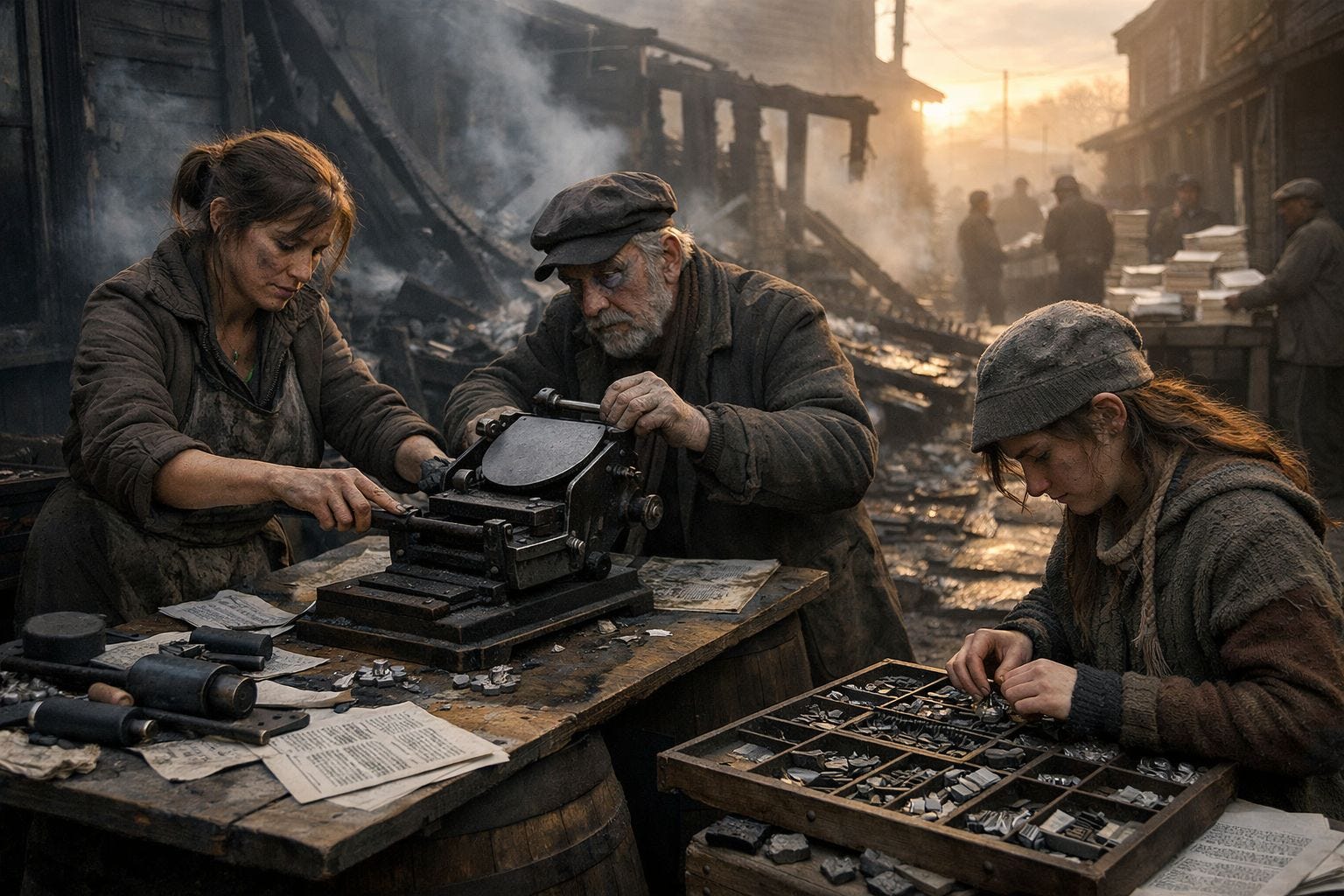
The California job case; the two smaller ones. She got them to the alley and went back for the galley frames and the ink. Emmett was behind her with the hand press, both of them in the smoke now. They got out through the back door and stood in the alley in the cold and watched the front of the shop go.
Pilar arrived at a run, her coat over her nightgown; three blocks in the dark. She stopped at the mouth of the alley and looked at the fire, then at the hand press in the dirt and the type cases. She studied Nora and Emmett standing there covered in ash.
“We still have the type,” she said.
Emmett looked at the hand press. He looked at the type cases. He crouched down, opened the California job case, and ran his fingers across the compartments, checking what survived. Something in the set of his shoulders changed.
“We need a flat surface,” he said.
They used the alley door pulled from its hinges and laid across two barrels. Emmett worked the hand press in the dark, his fingers finding each adjustment without needing to see it, forty years of the craft living in his hands independent of his eyes. Pilar set type by touch — each letter found by its nick, placed, spaced, and locked — faster than she had ever worked, her breath coming in small clouds in the cold air.
Nora wrote by lantern light on the back of a subscription ledger, then set the copy herself, working from Pilar’s end of the case toward the middle. Her hands knew the case now. She did not have to look.
The sun was coming when they ran the first sheet off the hand press.
One page, both sides; the affidavits condensed to their essential facts. The fire reported as fact — two in the morning, accelerant used, origin the front window, the Garrison Courier building a total loss. And at the bottom, in the largest type they had left:
The Garrison Courier is not in that building. The Garrison Courier is this page in your hands.
They ran two hundred copies in the street while the shop still smoked behind them. Nora’s arms gave out twice and she kept going. The man who ran the feed store across the street came out and watched for a while and then without a word began stacking the finished sheets. A woman Nora didn’t know brought coffee. By eight o’clock people were reading it on the boardwalk, in the street, in the doorways of the businesses along Main.
Emmett found her at the press when the run was done, both of them standing in the ash and the cold morning light.
“I knew,” he said.
She waited.
“The inspection report. Gerald had it in April.” He stopped there, looking at the hand press in the dirt. Started again somewhere different. “He let me go because I — I said things. When he told me he wasn’t going to print it.” Another stop. The good eye fixed on the middle distance, on nothing. “Nine men.”
Nora said nothing.
“I’ve thought about what I should have done. I’ve thought about it a lot.” He shook his head once, slowly, not finishing the thought. Whatever conclusion he’d been reaching for he didn’t reach it, or couldn’t say it, or both.
Nora looked at the burned front of the shop. She looked at the iron frame of the Washington press still holding its shape in the wreckage; the thing Gerald had loved, the thing that had taught her hands what they now knew.
“You came back,” she said.
“Didn’t seem like enough.”
She didn’t tell him it was enough. She didn’t tell him it wasn’t. She said: “It was what was needed.” Because that was the true thing and the only thing she could give him that wasn’t a lie dressed as comfort. He had earned the true thing.
Pilar was across the street, moving along the boardwalk, pressing the last copies into people’s hands. A woman took one and read it standing still in the cold. When she finished, she folded it carefully and put it inside her coat, against her chest, and held it there a moment before she moved on.
Aldous Crane was not arrested that day. The sheriff was his man and the judge owed him money. Nora had known from the beginning that the truth was not the same thing as justice. She had never promised justice. She had promised the truth, fixed in type, pressed into paper, put into hands.
The shop was gone. She had thirty dollars, a hand press, two cases of type, Emmett Greer, and Pilar Reyes.
She looked at the hand press sitting in the dirt of the alley; small, old, and sufficient.
She had work to do.
In an effort to keep my work accessible to readers of all income levels, Bathroom Breaks & Bedtime Tales by Sevastian Winters is supported through ads, affiliate links, and reader donations.
If you enjoy a story, please consider restacking it on Substack and sharing it on your social media. Your support helps more than you know—thank you, and I hope you enjoy my work!
Sev
Congratulations on your book. I am pre ordering next week. I cannot wait to read them.